White film on your dishes after a dishwasher cycle is almost always hard water mineral scale - calcium and magnesium deposits left behind when water evaporates - or a rinse-aid and detergent imbalance. In Tampa, where the municipal water supply runs hard at roughly 7 to 10 grains per gallon, that chalky coating shows up on glassware, silverware, and plastic containers more often than in most U.S. cities. The good news: you can usually clear it with a few changes at the sink, and if the film keeps coming back, a Appliance Repair technician can find the mechanical cause in one visit. This post walks through why it happens, how to test your water, what to fix yourself, and when the dishwasher itself is the problem.
The short answer: it is mineral scale, not soap
Why is my dishwasher leaving white film on dishes in Tampa FL? Because the water itself carries dissolved minerals that stay behind after the wash and rinse cycles finish. When a droplet of Tampa tap water dries on a glass, the water evaporates and the calcium carbonate stays. Multiply that across every plate, bowl, and fork in the load, and you get the cloudy, chalky haze homeowners describe as "white film."
That definition matters because it separates two very different problems. Mineral film is a water-chemistry issue you can often manage at home. A failing dishwasher - a clogged spray arm, a weak drain pump, a bad heating element - is a repair issue. If your dishes feel gritty and look cloudy but the machine runs normally, start with the water. If the film appears alongside standing water, long cycle times, or a dishwasher that will not drain, the machine needs attention.
Why Tampa water leaves white film on dishes
Tampa's water supply comes largely from the Hillsborough River and regional wellfields, and it runs harder than the national average. Hardness is measured in grains per gallon (gpg). Water below 3.5 gpg is soft; Tampa-area water commonly tests between 7 and 10 gpg, with some pockets in South Tampa and older neighborhoods pushing higher. That is squarely in the "hard" range.
Hard water does two things inside a dishwasher. First, it leaves scale on the dishes themselves. Second, it leaves scale inside the machine - on the heating element, the spray arms, the door gasket, and the interior walls. Over 12 to 24 months, that buildup reduces spray pressure and insulates the heating element, which makes the film worse and shortens the appliance's life.
We see this constantly in older Tampa housing stock. Bungalows in Hyde Park Appliance Repair territory often have original plumbing with galvanized or older copper lines that add their own mineral load on top of what the city already delivers. Downtown high-rises have the opposite issue - building-wide water softeners that are undersized or overdue for resin replacement, so residents get inconsistent water quality floor to floor.
Why is my dishwasher leaving residue Tampa? Six common causes
Dishwasher white film troubleshooting Tampa homeowners can do at home starts with identifying which of these six causes applies to your machine. Most loads trace back to one or two of them.
- Hard water mineral scale. The most common cause. Calcium and magnesium in Tampa tap water dry onto dishes as a white haze, especially on glass and stainless.
- Too little or the wrong detergent. Powder and gel detergents formulated for soft water underperform in hard water. Pods help, but only if the water is hot enough to dissolve them fully.
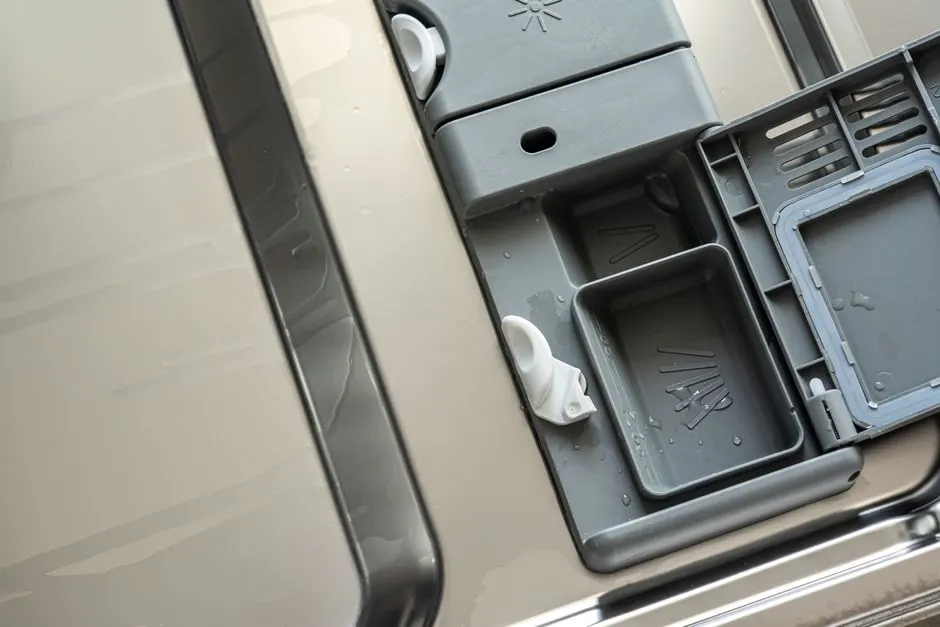
- No rinse aid, or an empty rinse-aid reservoir. Rinse aid changes the surface tension of water so it sheets off instead of beading and drying in place. Without it, hard water spots become hard water film.
- Water not hot enough. Dishwashers need 120°F to 140°F water at the tap to activate detergent and dissolve minerals. If your water heater is set to 110°F or the dishwasher's heating element is weak, detergent never fully activates.
- Clogged spray arms or filter. Food debris and scale block the spray holes. Water cannot reach the upper rack properly, so detergent and rinse aid never distribute evenly.
- Overloaded or improperly loaded racks. Bowls nested face-up trap water. Tall items block the spray arm. Both leave mineral-laden water sitting on surfaces to dry.
If you have ruled out loading and detergent and the film persists, the issue is usually mechanical. That is when a Dishwasher Repair Tampa FL visit makes sense - we test the inlet valve, heating element, and drain pump in about 45 minutes and tell you exactly what is failing.
How to fix dishwasher white film in Tampa, Florida
Dishwasher white film on dishes in Tampa, Florida how to fix is a sequence, not a single trick. Work through these steps in order and stop when the film clears.
Step 1: Test your water hardness
Buy a $10 to $15 test strip kit or ask your water provider for a recent hardness report. If you are above 7 gpg, plan on rinse aid and a hard-water detergent permanently - this is not a one-time fix.
Step 2: Run a dishwasher cleaning cycle
With the machine empty, place a cup of white vinegar upright in the top rack and run a hot cycle. Follow with a cup of baking soda sprinkled across the bottom and run a short hot cycle. This dissolves scale on the heating element and interior walls. Do this monthly in Tampa.
Step 3: Switch detergent and add rinse aid
Use a hard-water-specific pod or powder. Fill the rinse-aid reservoir to the line - most dishwashers use about 3 to 5 mL per cycle, and a full reservoir lasts roughly 30 loads. If your machine has a rinse-aid setting, set it to the highest dose.
Step 4: Check your hot water temperature
Run the kitchen tap until it is as hot as it gets, then measure with a thermometer. You want 120°F to 140°F. If it reads below 120°F, adjust your water heater - this alone fixes a surprising number of film complaints.
Step 5: Clean the filter and spray arms
Pull the bottom rack, remove the filter assembly, and rinse it under running water. Use a toothpick to clear the spray-arm holes. Reassemble and run a test load.
If the film is gone after these steps, you have solved it. If it returns within two or three loads, the dishwasher has a mechanical fault. Our team handles Kitchen Appliance Repair Tampa FL calls every week where the real culprit turns out to be a $40 inlet valve or a scaled heating element, not the water.
Common mistakes that make white film worse
Homeowners trying to fix white film often make it worse by reaching for the wrong solution. Watch for these.
- Adding more detergent. Extra detergent in hard water does not rinse cleaner - it leaves its own residue. Use the recommended amount, not more.
- Using lemon juice or acidic cleaners on stainless. Acid etches stainless steel and can pit the finish. Vinegar in a cup on the top rack is fine; pouring acid directly on the interior is not.
- Skipping the pre-rinse. Modern detergents need food particles to work. Scrape, do not rinse, unless you are running the load days later.
- Running the dishwasher without rinse aid "to save money." Rinse aid costs about $5 per bottle and lasts two to three months. Skipping it in Tampa water guarantees film.
- Ignoring a slow drain. If water pools in the bottom of the tub after a cycle, the drain pump or check valve is failing. That standing water redeposits minerals on every load.
One more: do not run a vinegar cycle and a bleach-based cleaner back to back. The combination can produce dangerous fumes. Space them at least one full cycle apart.
When to call a professional
Call a professional when the film persists after you have tested your water, switched detergent, added rinse aid, cleaned the filter, and confirmed 120°F or hotter water at the tap. At that point the dishwasher itself is failing, and no amount of vinegar will fix a weak heating element or a cracked spray arm.
Revanta Systems handles dishwasher diagnostics across Tampa. We test the inlet valve, heating element, float switch, drain pump, and spray-arm pressure, then give you a straight answer on whether the repair is worth it. If the machine is under 8 years old and the repair is under $300, fixing it almost always beats replacing it. If it is a 12-year-old builder-grade unit with a failed control board, we will tell you that too.
We also handle the rest of the kitchen when one appliance starts failing - Refrigerator Repair Tampa FL and oven calls often come in the same week as a dishwasher issue, because hard water and age hit every appliance in the house at roughly the same pace.
Frequently Asked Questions
Why is my dishwasher leaving white film on dishes in Tampa FL?
Tampa's water runs 7 to 10 grains per gallon of hardness, so calcium and magnesium stay on dishes after the water evaporates. That is the white film. It is a water-chemistry issue first and a dishwasher issue second.
How do I fix dishwasher white film in Tampa, Florida?
Test your water hardness, run a monthly vinegar cycle, switch to a hard-water detergent, fill the rinse aid, confirm 120°F or hotter water at the tap, and clean the filter and spray arms. Most homeowners see clear dishes within two loads.
Who repairs dishwashers near me in Tampa?
Revanta Systems repairs dishwashers across Tampa, including Hyde Park, Downtown, South Tampa, and Westshore. We diagnose the machine in one visit and carry common parts - inlet valves, heating elements, drain pumps - on the truck.
Does hard water cause white film on dishes in Tampa FL?
Yes. Hard water is the number one cause of white film on dishes in Tampa. At 7 to 10 gpg, the mineral load is high enough that even a perfectly working dishwasher will leave spots without rinse aid and a hard-water detergent.
How often should I clean my dishwasher in Tampa?
Monthly. Tampa's hard water builds scale faster than soft-water cities. A monthly vinegar cycle plus a quarterly filter deep-clean keeps the heating element and spray arms clear and extends the machine's life by several years.
Get help with Appliance Repair in Tampa
If white film keeps coming back after you have done the water test, the rinse aid, and the cleaning cycle, the dishwasher has a mechanical fault we can find in one visit. Call Revanta Systems at (813) 954-6004 and we will diagnose it, quote the repair upfront, and get your dishes clean again.